
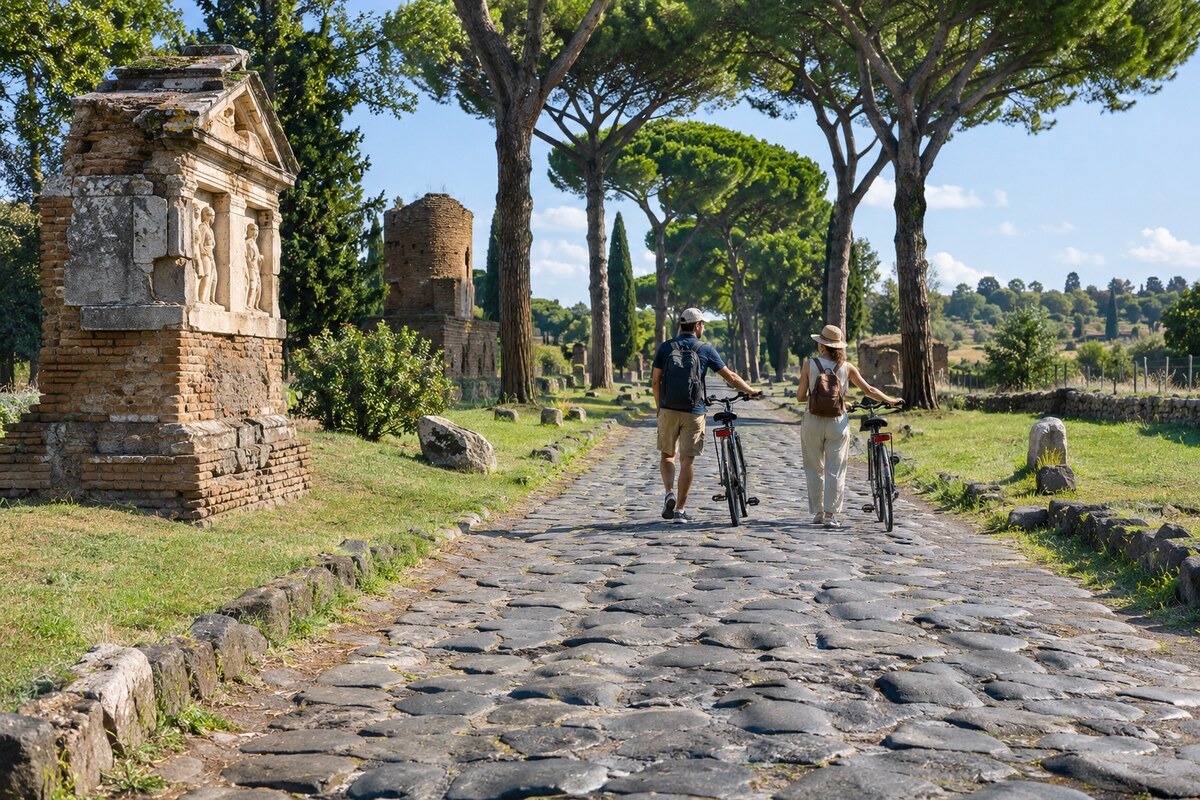
Rome’s Appian Way is not a single monument to tick off: it is a long archaeological landscape where Roman tombs, umbrella pines and ancient paving share the road with everyday life. A Sunday is the most comfortable time to explore because Via Appia Antica is closed to ordinary traffic on public holidays. This guide proposes a flexible route that works on foot or by bicycle and leaves room for the sites you actually want to enter.
Why walk the Appian Way?
Built from 312 BCE under the censor Appius Claudius Caecus, the Via Appia first linked Rome with Capua and was later extended south. Its engineering and influence are central to the serial property Via Appia. Regina Viarum, inscribed on the UNESCO World Heritage List in 2024.
The appeal is physical as much as historical. Beyond the busier entrance stretch, the road becomes a ribbon of worn basalt blocks bordered by tombs, fields and pines. You feel the scale of the ancient route by moving through it slowly.
Route at a glance
- Short version: Cecilia Metella to Casal Rotondo and back, roughly 7–8 km.
- Long version: continue towards Villa dei Quintili, roughly 10–12 km depending on your start and exit.
- Time: allow 3–5 hours, more if you enter archaeological sites.
- Surface: asphalt, gravel and uneven ancient basalt; ordinary city bikes can be uncomfortable.
The route is not a perfect linear trail. Some attractions have separate entrances, and transport changes periodically, so consult the official archaeological park visitor information on the morning of your visit.
A practical Sunday itinerary
1. Start near Porta San Sebastiano
Begin at Porta San Sebastiano, one of the best-preserved gates in the Aurelian Walls. The early kilometres are useful for understanding how the ancient road left the city, but they also contain modern traffic junctions. If you prefer to save your energy for the quieter section, take public transport closer to Cecilia Metella.
2. Pause around San Sebastiano
The basilica and catacomb area marks an important transition between urban Rome and the more open road. Catacombs require their own visit and timetable; do not assume they are included in the Appian Way archaeological park ticket.
3. Visit Cecilia Metella
The massive cylindrical mausoleum at the third mile is the route’s clearest visual anchor. It later became part of the medieval Caetani fortress. The site is open Tuesday to Sunday, with seasonal hours. The park currently offers both a dedicated ticket and a multi-site pass, but prices and conditions can change.
4. Continue past Capo di Bove
About 500 metres farther on, Capo di Bove preserves the remains of Roman baths beneath a modern estate. As of November 2026 the complex is temporarily closed for restoration, so treat it as an exterior waypoint and check the park’s official notice before travelling.
5. Follow the basalt towards Casal Rotondo
This is the section many visitors imagine: wheel-rutted stone, scattered funerary monuments and long views framed by pines. Casal Rotondo, a large circular tomb later reused as a farmhouse, makes a sensible turning point for a half-day walk.
6. Extend to Villa dei Quintili
For a fuller day, continue to the Villa dei Quintili, the largest residential complex in Rome’s suburbs. It belonged to two senatorial brothers before becoming imperial property under Commodus. Entering the villa requires extra time, and the last admission is earlier than the general closing time.
How to plan the walk well
Choose the day and direction
Public holidays, including Sundays, offer the calmest road conditions. Even then, expect residents, service access, cyclists and occasional vehicles at crossings. A practical option is to start near Cecilia Metella and walk outward, then return by public transport from Villa dei Quintili or retrace your route. Check ATAC or Roma Mobilità before departure.
Wear proper shoes and carry water
The original basalt is beautiful but hard and irregular. Choose shoes with grip and cushioning. Shade is discontinuous, fountains are not guaranteed along every stretch, and summer heat can be intense. Bring water, sun protection and a small snack.
Cycle only if the surface suits you
A bicycle covers more ground, but narrow tyres bounce badly on the ancient stones. A trekking bike or mountain bike is more forgiving. Walk your bike through crowded or particularly rough sections and use only authorized paths.
Accessibility and families
The historic paving, gravel and uneven verges make parts of the route difficult for wheelchairs and pushchairs. Families can enjoy the short version, but children should stay close near road crossings. Consult the park’s accessibility information to choose individual sites with suitable entrances.
Connect the Appian Way with the rest of Rome
For an introduction to the city before this independent outing, browse the Rome free walking tour. You can also build a broader day with our Rome day itinerary, look for quieter corners in the hidden Rome guide, or compare more free walking tours and compatible experiences. For a self-guided rhythm, use Best Free Tour’s independent audio-guide options where available.
Frequently asked questions
Is walking on the Appian Way free?
Yes. Walking along the public road and park landscape is free. Individual archaeological sites such as Cecilia Metella and Villa dei Quintili charge admission unless you qualify for free entry.
Is the Appian Way completely car-free on Sunday?
The official Rome tourism information states that Via Appia Antica is closed to traffic on public holidays. It is still a living area, so crossings, authorized access and local movements remain possible. Stay alert.
Is it better to walk or cycle?
Walking is best for details and short routes. Cycling is useful for reaching Villa dei Quintili and farther milestones, provided you are comfortable on rough basalt.
How far should a first visit be?
A 7–8 km return walk between Cecilia Metella and Casal Rotondo gives a satisfying first experience. Extend towards Villa dei Quintili if you have most of the day.
Should tickets be booked in advance?
The road itself needs no booking. Some park sites, guided visits and special openings may require reservation. Check the official park website on the day you plan to go.
Explore Rome at your own pace. Pair this route with an independent audio guide, then choose a Rome free walking tour or a compatible experience for the rest of your stay.